Showing posts with label Book Reviews. Show all posts

Saturday, March 14, 2009

BOOK REVIEW: "The Long Fall (1st Leonid McGill Mystery)" by Walter Mosley


If there is one thing that Walter Mosley does well, it’s developing strong, flawed male characters that move the reader enough to give a damn about the outcome. From Easy Rawlins to Socrates Fortlow to the trigger-happy Mouse, each one occupies a space in the imagination that allows for the possibility that he just might exist. And that right there is the hook, that element of Mosley’s works that intrigues his audience and keeps it salivating. We either know someone who knows someone who used to tangle with an Easy-like figure, or we wish to the literary gods that our friends were that interesting. Or that resourceful. Or that true to life.


Leonid McGill is Mosley’s latest creation, a 50-something detective living in New York, whose past indiscretions have a way of reappearing whenever he commits to going straight. McGill used to handle his opponents in the ring, fighting well enough to command respect, but these days, all he seems to be doing is shadowboxing with his demons. He has a once-beautiful wife, Katrina, whom he doesn’t love or care much about, a woman with the cojones to birth two babies that share DNA with everyone but him. Her only reason for being around is a failed attempt to leave him for another man. His only reason for being around is to keep Twill, one of those other-man’s kids, from losing himself to his own demons. Theirs is an arrangement of, well, convenience, and the burden of that convenience leaves him emotionally twisting in the wind, all day, every day.


The McGill adventure starts off with the usual Mosley blast; a mysterious figure hires the detective to track down four guys who may or may not have been involved in a murder as teenagers. When the third one is found dead shortly after McGill contacts him, the private eye digs around to uproot the killer. What he finds en route to solving the case is classic Mosley: a litany of shady characters too outrageous to not be real; tainted cops only too happy to break their own laws; and double the violence found in a typical wild west flick.


The Long Fall has its shortcomings, primarily in that the main plotline lands kind of flat. The run-up itself is superb—action-packed and insanely suspenseful, and the subplots involve a pedophile taken down by a techno-savvy misanthrope and a mob-tied flunky searching for revenge. But the revelation at the end of who was pulling the strings of the four men’s deaths, and why they had to be manipulated, is a big disappointment; it’s way too far-fetched and beneath Mosley’s talent. Does that mean you should pass on this book? Not at all. Fall is still worth the time, and Leonid McGill is worthy of his boxing gloves.


--Dianha Simpson
imagineatrium.com

The Long Fall is released on March 24. Pre-order your copy today at your local independent bookstore.

Visit Indiebound.org to find your closest indy bookstore and keep your community thriving.

Thursday, March 5, 2009

BOOK REVIEW: "The Miracles of Prato" by Laurie Albanese and Laura Morowitz


In 1456, Lucrezia Buti and her younger sister, Spinetta, arrived at the Church of Santa Margherita convent in Prato, Italy, somewhat reluctant to devote their lives to God. As was common practice during the Middle Ages, the two women were forced, like other unmarried or widowed women who lacked the support of a male relative, to find protection against the world’s evils among the nuns. Spinetta, who was used to being sheltered, adapted rather quickly, having accepted her cloistered fate with optimism. But Lucrezia, described as bearing a striking resemblance to the Madonna (if such a thing can be known), was resentful for having had her life decided for her. What she wanted was the fairytale life of the local merchant’s wife, Signora de’ Valenti: To fall in love with a successful man, to become his doting wife, and to fill their home with beautiful children. Ultimately, Lucrezia felt disconnected from the Order.


Enter Fra Filippo Lippi, a painter and an Augustinian monk who, like Lucrezia, took his vows out of necessity rather than in response to a spiritual calling. As chaplain of the convent, it seemed Filippo tended to his clerical duties more out of obligation to the Church and to his art patrons for bailing him out of his multiple transgressions. See, Fra Filippo was more man than monk, saddled with the very human desire to lay down with the fairer sex. Having earned a reputation for routinely giving in to this temptation, he found himself at their mercy.


Severely in debt and behind on several commissioned pieces, Fra Filippo asked for special permission to use the novitiate Lucrezia as the model for the Virgin Mary. The monk—or rather, the man—was taken with the young woman’s beauty, and visions of her flawless face took refuge deep in his heart. To Filippo, Lucrezia was the epitome of perfection, and immortalizing her beauty as the figure of the Virgin Mother was the highest compliment he could pay to his Creator. The request drew outrage from the convent—their fear being rendering Lucrezia vulnerable to the older monk’s proclivities—but the Sisters were powerless to refuse a favor for the Medici family, Filippo’s principal backer. The romance that ensued between them scandalized the Catholic Church and sullied both their reputations.


Their story comes to life in The Miracles of Prato, (Laurie Albanese and Laura Morowitz), which is wonderfully written in the voice of the time. Each chapter follows the Liturgical Calendar, giving the reader insight into the influence the Church had over parts of Europe, and the authors put forth an extraordinary effort to remain true to religious politics. The result is an unsettling—if not altogether surprising—foray into sexual and dogmatic inconsistencies. Celibacy and faith, while noble pursuits, were preached by the clergy, but not necessarily practiced with equal diligence.


An intriguing character throughout Miracles is Sister Pureza, an older nun whose hidden back story mirrors Lucrezia’s in many ways. To reveal now the similarities would be to do a disservice to the reader (the foreshadowing alone hints at the parallels in their lives), but suffice it to say Pureza’s actions are less heartless than well-intentioned. Her devotion is not unwavering—she spends an inordinate amount of time questioning her faith—and this colors her interactions with the Order. Her hope, we come to realize, is to save Lucrezia, the beautiful novice, from suffering at the hands of the Church’s powerful hypocrites.


The Miracles of Prato is a worthwhile read for those who enjoy historical fiction. The devotedly religious may not appreciate the authors’ celebration—for lack of a better word—of Lucrezia and Filippo’s scandalous, yet saccharine sweet, affair. Nor will they warm up to the “indiscretions” of the Catholic clergy. But Miracles is still an important story because it exposes the reader to the nuns’ bubble-like existence and the attacks on faith to which they were routinely subjected. Pick up the book and let me know what you think.


---Dianha Simpson
imagineatrium.com

Learn more about the authors and the book by clicking here.
Visit Indiebound.org for more great reads or to find your local independent bookstore.

Tuesday, February 10, 2009

BOOK REVIEW: "Fool" by Christopher Moore


“This is a bawdy tale…”

Gross understatement, indeed. Trust me.
“Herein you will find gratuitous shagging, murder, spanking, maiming, treason, and heretofore unexplored heights of vulgarity and profanity…””

So continues Christopher Moore’s much-appreciated warning…right before he takes his audience through the literary equivalent of Amsterdam’s Red Light District. Well, a gladiator movie set in the Red Light District, to be exact.

Fool parodies several of William Shakespeare’s plays from the viewpoint of King Lear’s court jester, Pocket, or the Black Fool, as he is better known. Pocket does his job well, which is namely to keep his boss sufficiently amused so that the king would return the favor and spare him a hanging. True to this function in a Shakespeare work, his acerbic wit reflects the license court jesters were given…although one gets the feeling that Moore exaggerates just a bit. How so? It might be safe to say that calling Lear’s oldest daughter, Goneril, for example, an “insane tart” and advising his master to “get the girls some teachers who aren’t nuns” for “fuck’s sake,” would surely have led to a real jester (or anyone else) losing his life. But under Moore’s Lear’s protection Pocket runs amok, hurling well-crafted insults at all who tick him off. For his tenacity and creativity he earns ample heaps of wrath as well as the constant threat of finding his severed head on a stick. Much like his scepter sidekick, Joke.

For those of you who may have forgotten the plot, allow me: King Lear, faced with the daunting task of dividing his kingdom among his female heirs, instructs his three daughters to profess their love for him. No, a simple “I love you” won’t do; the pronouncement Lear expects is to be verbose, grandiose, befitting the pomposity of his station. The size of each girl’s property, then, will depend on her ability to make him swoon.

With her father’s court looking on, Goneril launches into a syrupy-sweet declaration of her unrelenting affection: “Sir, I love you more than words can wield the matter/Dearer than eye-sight, space, and liberty/Beyond what can be valued, rich or rare/No less than life, with grace, health, beauty, honour/As much as child e'er loved, or father found/A love that makes breath poor, and speech unable/Beyond all manner of so much I love you.” Exactly what Lear’s ego wants to hear.

Next up is his middle daughter, Regan, who, not to be outdone, lavishes praise upon her father’s thirsty ears: Sir, I am made/Of the self-same metal that my sister is/And prize me at her worth. In my true heart/I find she names my very deed of love/Only she comes too short/that I profess/Myself an enemy to all other joys/Which the most precious square of sense possesses/And find I am alone felicitate/In your dear highness' love.”

Lear, drunk off the attention, immediately turns to Cordelia, his youngest daughter and obvious favorite: “What can you say to draw/A third more opulent than your sisters? Speak.”

“Nothing, my lord.”

Although she does expound on the pointlessness of the exercise by explaining her love is indeed sufficient and genuine, Cordelia’s simple statement—also meant to expose the silliness of this charade—greatly offends Lear. Her honesty, in turn, gets her banished from the kingdom, and she is sent away empty-handed.

Where Pocket comes in—aside from holding court as the narrator—is as the mastermind of a plan to exact revenge on Edmund, the bastard son of Gloucester obsessed with undoing Edgar, his legitimate heir half-brother. He includes in this nefarious plan Goneril and Regan for not only double-crossing the king but also for treating Lear and Cordelia poorly. One senses, though, that he mostly wants to stick it to them for the hell of it. “I’m not built for these dark dealings—I’m better suited for laughter, children’s birthdays, baby animals, and friendly bonking.” (189)

The genius in Fool, however, is the painstaking detail that Moore invests in this very central character. Pocket’s back story—as absurd as it is (he was raised in a convent by a Mother Superior who shaved her beard daily and was blessed with an Adam’s apple)—exists not so much to inform who and what he is at the present—Moore’s not that sentimental—but to give credence to his role as the king’s confidante. Once we learn that Lear [NOT GIVING IT AWAY!] because he [STILL NOT GIVING IT AWAY!], we understand why Pocket loves the old man so much. Even though he calls him a “decrepit old looney” and an “arrogant old tosser.” To his face.

Moore also allows Pocket a cast of characters equally inane—from a well-hung apprentice named Drool who mimics voices to randy wenches who conveniently fall out of their dresses while doing the laundry to villains who must be coached through their villainous, um, -ness to a potty-mouthed king whose stature diminishes by the second to whoring princesses who sleep with Spaniards that speak no English to rhyming ghosts who enjoy a good shag.

There’s always a bloody ghost.

Yes, Fool is bawdy, and just how so continues to make me blush. Moore’s tome is very definitely replete with “gratuitous shagging, murder, maiming…” etc. If you are of a delicate sensibility and need your Shakespeare fix to follow strict tradition, I would implore you to take a pass. Err on the side of caution, you might say. You would, however, be missing out on something special. Fool is delightful—in a sadistic kind of way—and I, as a former English major, appreciate the intelligent, goofy take on the ostentatious elements of The Bard.


---Dianha Simpson
imagineatrium.com

Fool is out now.
Buy your copy at your local independent. Visit Indiebound.org
Win an autographed copy of Fool. Find out more at www.chrismoore.com

Friday, January 23, 2009

BOOK REVIEW: "I Am Potential" by Patrick Henry Hughes


Probably not the best book for a pregnant woman to be reviewing, the first few chapters of I Am Potential: Eight Lessons on Living, Loving, and Reaching Your Dreams detail the devastation when first time parents find out that their newborn son is far from physically normal and healthy. Patrick Henry was born without eyes and with shortened limbs that limit his upper body range and make it impossible for him to walk.

I moved quickly through those opening paragraphs compelled by a vain hope that right there on page 34 or 35 a miracle would be pronounced - the doctors would realize that in fact Patrick Henry could develop eyes to see the world through and sprout strong limbs to play football with his father. But that was not the story Patrick Henry and his father would, or wanted, to tell.

Instead both father and son alternately tell the reader about Patrick Henry's path through young life --- the operations, the hope and distress, the young boy's selflessness, his courage and in particular, his passion for playing the piano.

The "eight lessons" in the book's subtitle might signal warning bells to those fatigued by the self help genre, and "I am potential" is certainly a classic self help presentation. But at least there's no lecturing here, no guided visits to the depths of your being in the hopes of transforming your soul, no promises of self realization. It's just a simply told tale of lives that would have been less than whole without the determination and open heartedness of a boy named Patrick Henry.


---Niamh Bushnell
imagineatrium.com

Friday, January 16, 2009

BOOK REVIEW: "Cads, Princes & Best Friends: A Tale of Lust, Love & Redemption" A Memoir by Danielle Coulanges

“God answers prayers. Although God’s answer is immediate, the particular way it unfolds may take time.”

When the memoir begins Danielle is living in downtown Jersey City , New Jersey in the 1990s. For the last decade she has allowed herself to be trapped in an unhealthy relationship with a real cad. This is a woman dealing with some heavy self esteem issues; she finally breaks away from this doomed relationship and begins working on recreating her life and ultimately herself. Desperate to start her life over, she needs to find a rewarding career, a loving relationship and a spiritual home.

Danielle is looking for a Christian church that will inspire her to become a more spiritually grounded person. Central to the story is the author’s blossoming faith in God which parallels her growing faith in herself. Her personal growth and spiritual growth are closely linked in this story.

Danielle Coulanges’s first book, Cads, Princes & Best Friends: A Tale of Lust, Love & Redemption, is a raw memoir that reads like you are literally reading pages of her diary and peering into her most intimate world. The author was born in the Caribbean island of Haiti and came to the New York City area at the age of sixteen in the mid 1970's. She's had careers as a fashion designer, entertainer, compliance officer and business woman.

This book is certainly not a roller coaster ride of excitement, but it is a story of a real person dealing with real situations. I think many readers will see themselves in this tale of lust, love and redemption and would recommend this to anyone who needs to make changes in her life or is on a spiritual quest.


Friday, January 9, 2009

BOOK REVIEW "Fresh Food From Small Spaces" by R.J. Ruppenthal


Oh, the timeliness! Oh, the comforting knowledge this book gave me! Timely and comforting, because, being blessed with something rather rare in the NYC area, a backyard garden that I've cultivated for years, I saw it suddenly threatened by construction occuring on the empty lot next door! Instead of a vacant space, I was becoming hemmed in by a four story building, the first level of which was an ugly concrete wall along the whole left side of my garden! Apprehensive about possible loss of sunlight, I worried it might not be possible to grow my favorite vegetables, tomatoes and eggplants next summer. Then along came this book, filled with reassuring facts, telling me such things as, "even when there is little direct sunlight, light-colored concrete walls provide enough reflected light to grow many vegetables," and suggested trellises be placed all along those bare, ugly walls.

It spoke of container gardening and tiered gardening, so my tomatoes could reach for the sun more effectively. Some of the book's suggestions, such as chicken raising and honeybee keeping, are really not feasible for the city---although it says they are. Chapter eleven has gotten me intrigued by...of all things, composting using worms, which can be (the book says) easily done in one's basement or garage using a couple of plastic bins. I am going to try it! It's ecologically sound, not smelly or unsanitary, and a good way to dream away the winter months while (hopefully) producing rich compost to fertilize next summer's garden which, according to this book, can be prolific and beautiful, four story building or not!


---Jane Pedler
imagineatrium.com

Wanna buy the book? Find it at an independent bookstore near you at Indiebound.org.

Monday, December 29, 2008

BOOK REVIEW: "The Shape of Mercy" by Susan Meissner


The Shape of Mercy is a rather simple story, told from the viewpoint of Lauren Durough, a college sophomore born into affluence. Her family’s money has afforded her many luxuries that she freely discloses at every turn, yet each casual mention of this inventory is coated with disdain. Lauren feigns rebellion, such as opting for a dorm room at UC-Santa Barbara in lieu of a condo at Stanford, and she readily—and frequently—applauds herself for choosing to live among the commoners. But to those who live paycheck to paycheck and struggle to survive, Lauren’s meager acts of rebellion are reminiscent of those of the hippies of the 60s and 70s, who could afford to spend their days fighting "The Man" and finding themselves because Mom and Dad were footing the bill.

One such mutinous decision finds our quasi-protagonist applying for a job transcribing the diary of Mercy Hayworth, an 18-year-old woman accused of bewitching her peers during the frenzy of the Salem witch trials. Lauren’s boss, Abigail Boyles, is a direct descendent of the diary’s author, and thus guards her familial treasure like an overprotective mother. The eccentric, crotchety Abigail hires Lauren specifically because she, too, is an only child borne into great wealth. What she ultimately needs from Lauren is two-fold: to give Mercy’s diary entries a place in history, and to help her peel back the layers of guilt that have suffocated her for most of her life. A tall order for a sheltered college student, indeed.

The problem with Meissner’s novel is that she fails to develop any of the characters beyond Mercy into ones that the reader should care about for longer than it takes to get through the book. Even Lauren’s supposed transformation rings hollow because its catalyst is no more believable than those who set it in motion. Her moral compass, appearing in the form of weak working-class stereotypes, are Esperanza, Abigail’s loyal Hispanic housekeeper; Clarissa, her working-two-jobs-to-put-herself-through-school roommate; and Raul, the devilishly good-looking medical-student love interest who is poor now but probably won’t be in the future. The first two routinely admonish Lauren for viewing life through green lenses while perched up high, languishing among The Haves. But, when the opportunity presents itself—Esperanza’s gifted condo and Clarissa’s salmon steak served on a silver platter by the Durough’s pool—both jump at the chance to abandon The Have-Nots. And Raul? Well, he remains devilishly good-looking and, like in all fairytales, rides in at sunset to save the day a la Prince Charming. How apropos for the princess.

The Shape of Mercy’s story-within-a-story would be worth a read if it was not mired in clunky dialogue (what’s with all the exclamation points?) and an uninteresting primary plot. What Meissner should have done was expand Mercy’s story and keep the parallels strictly between her and Abigail’s lives; both characters are strong enough and mysterious enough to hold the reader’s attention. Juxtaposing the younger woman’s naïveté with the older woman’s wisdom would have eliminated the need for pointless references to modern day materialism and added depth to the reading experience.


--Dianha Simpson
imagineatrium.com

Wednesday, December 17, 2008

BOOK REVIEW: "A Lion Among Men" by Gregory Maguire


A Lion Among Men, written by Gregory Maguire, is the story of the life of the “Cowardly Lion” named Brrr. It was a little slow going in the beginning and at first seemed overly written for my own tastes. But as the story progressed, the style was very fitting in reflecting the life and mannerisms of Brrr. At first glance A Lion Among Men seems to be about the political on goings of the different lands in Oz. Things are in turmoil with the death of the Wicked Witch of the West and the quick exit of the Wizard of Oz.

Brrr is on assignment as court reporter to the Emerald City Magistrates and he has sought out an oracle named Yackle to question her about her knowledge of a certain Madame Morrible. Yackle is an ancient human who is trying to die but has not yet been released from this life. It takes her a while to “warm up” to conversation with Brrr, first demanding to know his history before sharing any of her memories.

He at first tries to brush off her requests but soon is sharing the story of his life, how he became famously known as the “Cowardly Lion” and the events that happened up until the point of the interview. I wanted to feel sympathy for Brrr, given his beginnings as an abandoned lion cub. He learned to protect his own life by cowering down in the face of danger and playing dead. While this worked the first time he encountered danger, he continued to employ this same technique to every situation he encountered, thus entangling himself even more deeply than he ever wanted. What began as sympathy turned to just pity as his difficulty with facing challenging situations kept recurring. His ideals were enacted in his head, but he never went further than that, letting fate control him.

There is also a side story going on about a special clock being guarded by a dragon and a small group of attendants. They are also traveling through the land and eventually cross paths with Brrr, but I won’t give away the reasons why as this is a turning point in the story.

Overall, A Lion Among Men is not an easy read, but it pulls you in and gives you the chance to understand how early events can shape someone’s (in this case a talking lion’s) future life.


---Christine Moss
imagineatrium.com

Wednesday, December 3, 2008

BOOK REVIEW: "The Transition Handbook" by Rob Hopkins

The Transition Handbook: From Oil Dependency to Local Resilience is an incredibly important book because it provides an introduction to two critical and related issues that we face today. Rob Hopkins first introduces Peak Oil (which received increasing public attention with skyrocketing oil prices this spring) and then explains the role that global warming will play in exacerbating the Peak Oil crisis. Following the description of the crisis, the author attempted to provide a prescriptive formula to address the crisis in individual towns.

In the first section, describing the Peak Oil crisis, Hopkins explains why some of the “new” sources of oil are insufficient. As someone who has not followed the Peak Oil crisis closely, I appreciated some of the simple analogies that Hopkins provided, including his description of retrieving oil from the tar sands in Alberta.

“Tar sands are akin to arriving at the pub to find that all the beer is off, but so desperate are you for a drink that you begin to fantasize that in the thirty years this pub has been open for business, the equivalent of 5,000 pints have been spilt on this carpet, so you design a process whereby you boil up the carpet in order to extract the beer again.”

What was challenging, however, was the use of oil prices along as evidence that the crisis is hitting a pivotal point. While supply had an important impact on price this past spring, so too did hedge fund speculation and the precipitous decline of the American dollar versus other world currencies. The Peak Oil issue did not disappear this fall when oil prices fell, but the oversimplification could lead some people to conclude that it did. The author would have been better served to explain the process to “develop” oil reserves (thousands of years) versus the pace at which those reserves are being depleted.

In addition, it would have been helpful to have a more diverse set of sources to support the peak oil claims (since they exist). There are reports even from the US State Department that indicate that peak oil will be reached sometime between 1990 and 2010, and that the maximum oil reserves are ~2,100 billion barrels (State, 1982). These types of references would help to bolster the argument for the lay person reading the book.


The author is much more effective at linking the peak oil crisis to global warming. Although set in a British context, Hopkins clearly helps to debunk the current political claims that the way to solve the oil crisis is to (A) drill more and (B) use America’s extensive coal reserves to “create” oil. He provides a well articulated argument as to why these solutions would only serve to exacerbate global warming. It would have been helpful to explain the inclusion of that topic in the title, since it is of vital importance to Hopkins’ argument.

Hopkins' solutions and recommendations, such as the 12-step transition town program, are at times overly-prescriptive, overwhelmingly detailed, and difficult to follow. In addition, the view of the world that he paints post peak oil is so entirely unappealing to a huge segment of the population (no global travel, extreme re-urbanization, etc) that it is hard to understand how people would buy-in to the plan. The same solution would be more powerful if it were presented as a “realistic” view of the world, where there are both opportunities and challenges. It is clear that people need to act before the crisis hits, but it is unclear how a large portion of the population will be motivated by Hopkins’ vision. Hopkins does not entertain the idea that transformational technologies could help to smooth the transition (or even a step change in the way we utilize energy for existing technologies). If the author presented his “power down” view along with a call to encourage research into how to do more with less energy, the book would have broader appeal. While he explains why current alternative energy solutions would be ineffective (which was extremely helpful context for those of us who didn’t previously understand that it takes energy to make energy), it was a dismal view of the future that the only way to survive would be retrenchment into a world that looks a lot more like the 1900s than the future.

In spite of the above, this book is great first introduction to the concept of Peak Oil and the need to Transition. It has certainly motivated me to action, if only to research more about what can be done on a personal level to help combat this issue.


--

Monday, December 1, 2008

BOOK REVIEW: "A House in Fez" by Suzanna Clarke


My dream of living in Mexico for a year drew me to read A House in Fez, Building a life in the ancient heart of Morocco, by Suzanna Clarke. Like many of us, the Clarkes went on vacation to an exciting, exotic country and began to imagine what it would be like to live there. The difference is, they took the leap, bought an ancient house in need of major renovation and survived to share their fascinating journey.

Suzanna Clarke is a photo journalist and her writing style is lively, informative and entertaining. Her open-hearted embrace of the Moroccan culture had me thinking it might be appealing to hear loudspeakers calling me to prayer at dawn each day. And I found her adoption of stray cats and abused chameleons truly endearing.

Suzanna and Sandy Clarke are certainly the optimistic, adventurous sort, taking on their renovation project with her high school level French and his smattering of the local Darija dialect of Arabic. Reading this book, I was always eager to learn what happened next, whether they were negotiating with shady inspectors, discovering long buried treasures behind ancient walls or having lumber delivered by donkeys. In fact, the book helped me give my daughter, an interior designer in New York City, a fresh, new perspective in her work. Talking on the phone one day, I couldn't resist telling her, "You think that's bad, be glad you aren't renovating a house in Fez and dealing with runaway donkeys!"


--Jeanne Moren
imagineatrium.com

Purchase A House in Fez at your local, independent bookstore. Find it here.

Wednesday, November 26, 2008

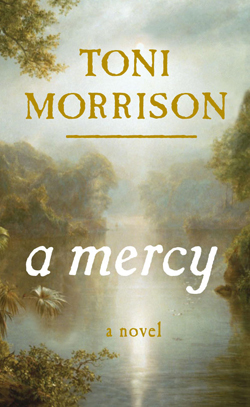
BOOK REVIEW: "A Mercy" By Toni Morrison


Toni Morrison is back! A writer of singular talent, her work is always provocative and elegant. However, recent novels such as Love and Paradise haven't quite reached the heights of her masterpieces Song of Solomon, Sula, and Beloved. Well, after reading her newest novel, A Mercy, I am delighted to say that Ms. Morrison is at the top of her game.

A Mercy, like Beloved, focuses on the lives of the most powerless people in society. In Beloved, the action centered on enslaved African-Americans. A Mercy, set a century earlier, explored of the lives of indentured servants—black, white, and Native American-- a dimension of American history of which many readers will be unaware.

A Morrison novel wouldn't be a Morrison novel without a terrible tragedy at its heart. I won't spoil it here, but Florens, the novel's main characters, struggles to mend her spirit, although the act that caused it is the "mercy" of the title. As in Beloved, we see how destructive a mother's love can be.

A Mercy is a short novel, but potent like strong whiskey. Take your time with it, as each sentence packs a wallop and if you don't watch yourself, you'll be hungover when you're done. These characters will haunt you and won't easily let you go.


For the TRUE Morrison fans out there, you can hear her read from A Mercy on NPR.

Or watch a great interview with Charlie Rose here.


--Tayari Jones
imagineatrium.com


Tayari Jones
is the author of Leaving Atlanta and The Untelling.
Check her out at tayarijones.com

Saturday, November 22, 2008

BOOK REVIEW: "Ghost Radio" by Leopoldo Gout


Ghost Radio, the debut novel from producer/director/graphic artist Leopoldo Gout, is an enjoyable, easy read, and will strike a chord with those that remember the punk scene of the late 1980s, as well as fans of comic books and the paranormal.

The story involves two boys, Gabriel and Joaquin, brought together by a terrible tragedy in their teenage years. Bound together by this experience, they discover a common love of music. They form an experimental punk band, and during a pirate radio gig in Mexico, another terrible tragedy strikes. Joaquin wakes up in the hospital without Gabriel, and with no memory of how he got there.

After the loss of Gabriel, Joaquin channels his energy toward a radio call-in show he hosts called “Ghost Radio”, where callers talk about their paranormal experiences. Bolstered by his technical producer Watt and his beautiful Goth girlfriend Alondra, Joaquin is doing alright. He’s stable and his show has just been picked up in the States—yet when we join the story, unexplained things have started happening to him, and he is starting to get stuck between the stories his callers tell and reality as he knows it.

I had a good time reading this book. As a punk-loving former teen from the time period, I caught the inside references and recognized the names of the bands, although I actually swung between nostalgia and feeling like the name-dropping was a little heavy. However, I really love the fact that the characters are Mexican, and that the story doesn’t treat Mexico as a Third World country or some exotic locale, but as a legitimate place to live, with a youth culture that both mirrors the United States, yet preserves its own past and history.

Also, the concept of the show “Ghost Radio” is fantastic. The ghost stories woven throughout the narrative are the best parts of the novel. In each one, you can sense the caller’s particular viewpoint, and how confused they feel by their contact with the paranormal. Plus, the stories are just realistic enough that they’re pretty spooky.

However, for all the enjoyment I got out of the first two thirds of the book, the ending was completely confusing. The publisher describes this book by saying that Joaquin “opens the doorway into the paranormal, giving voice to the dead and instigating an epic battle for the souls of the living.” What epic battle? Souls of the living? I don’t know that anyone’s soul was really in jeopardy. Maybe Joaquin’s. It was really hard to tell, though. To me, the novel was like one of those episodes of the old “Twilight Zone” show, where the boundaries between reality and madness/paranormal/aliens/etc. are blurred and weird things start to happen, but the show ends with the main character realizing they’re totally screwed, so you never find out what happens. Ghost Radio's ending involves radio waves, electricity, the missing Gabriel, some sort of Mayan cult, and perhaps messages from beyond the grave, but depending on your expectations, might leave you a little frustrated, as it did me.

Aside from the disappointing ending and jarring use of multiple perspectives, the novel was still really enjoyable. Also, each chapter is illustrated with Gout’s fantastic drawings. If you like old-fashioned ghost stories and appreciate the Dead Kennedys, you’ll enjoy Ghost Radio.


---Kimberly Guinta
imagineatrium.com


For more info on Ghost Radio, visit the Official Site

Tuesday, November 11, 2008

BOOK REVIEW: "Conspiracy in Kiev" by Noel Hynd


I was left with a mixed feelings about Noel Hynd's thriller, Conspiracy in Kiev. On the one hand, it includes everything you want in a good thriller - lots of exciting locations, well-planned murders, dramatic explosions, morally ambiguous underworld figures. On the other hand, it took a lot longer to wade through than your average spy novel, partly due to the continuing annoyance of the heroine's cloying perfection and the very occasional annoyance of some really bad writing.

Conspiracy in Kiev tells the story of Alex LaDuca, a Treasury employee charged with investigating financial scams like the ubiquitous "send your money to Nigeria to help out the king who will reward you handsomely" emails. The plot really gets going when Alex is tapped to go to the Ukraine in advance of a controversial and dangerous Presidential visit. Her ostensible purpose is to broker a deal with (and keep an eye on) a major local gangster who owes the U.S. money. She earns this assignment because of her almost too-good-to-be-true resume - fluent in five languages, athletic, beautiful, brilliant, composed, and morally flawless. After brief training in the Ukrainian language she is off.

Without giving away the exciting moments, Alex ends up embroiled in an international event much larger than tax evasion. After her trip to the Ukraine, Hynd's ambition really shows itself - he continues the story several months past what could have been the climax of the novel and manages to rebuild excitement around a second line of plot development, this time centered in South America, but all spiraling back to the events in the Ukraine.

Hynd clearly is a master of plotting and this skill is what made the book most enjoyable. What detracted from the pleasure was Alex's otherworldly goodness - I kept waiting for some small chink in her armor and was disappointed to find none. She has bad moods and personal traumas to settle, but her essential character, besides having all the skills and talents listed above, is one of perfection - she is kind, wise, sensible, assertive, dedicated, pious, nearly fearless, and makes the right moral choice in every instance. At times this got almost ridiculous. This appeared to be Hynd's main concession to the genre of "Christian mystery" he was writing in, aside from character development related to Alex's church attendance. Perhaps he did not want his protagonist to show any un-Christian flaws. The only other qualm I had in reading this novel was the occasional turn of phrase that was jarringly awful. For instance, "The design was endlessly intricate and delicate, as if made by hands guided by angels." Or consider this description, smack in the middle of a good action sequence: "The sweat rolled off her so furiously that she felt as if a fat person were lying on top of her."

Despite this, Hynd's novel is enjoyable, if light, reading. I also learned something about the intricacies of the European criminal underworld. He tied up all his loose ends, leaving the completist in me satisfied by the scope of this ambitious and interesting novel.


---Katy Wischow
imagineatrium.com

Saturday, November 1, 2008

BOOK REVIEW: "Inkdeath" by Cornelia Funke


Inkdeath is the third volume of the Inkheart trilogy. The story of Meggie, her parents, and the other characters picks up where Inkspell left off. By the end of Inkspell, a central character, Dustfinger, had been taken away by the White Women; and the evil Adderhead had been made immortal by Meggie’s father, Mo, in a bargain to win his family’s life and freedom.

Inkdeath begins with the quest (mainly of the boy Farid) to bring Dustfinger back into the Inkworld. The main part of the plot, however, revolves around the adventures of the Bluejay, Mo’s chosen identity when he is with the Black Prince and his men. It is a classic struggle of good against evil. At the heart of the struggle lies Mo’s goal of reversing the damage he did by making the Adderhead immortal. The Adderhead must die in order for good to win out.

At the core of the Inkheart is the interweaving of fiction and reality and the erasing of boundaries between worlds. The central premise of the first book is that someone with the gift to do so can read characters out of books and people into books. At first we know only that Meggie’s father, Mo, can do it, but later we find out there are others as well.

Coming in at 563 pages and 81 chapters, Inkdeath is a book of considerable heft, especially for smaller (younger) hands. The plot takes many turns, but not especially difficult to follow. The relatively short chapters neatly break the big book into manageable bites.

Since I have read both prior volumes it is a bit difficult for me to judge whether it could stand on its own, but I believe it can. I was a bit disappointed with the second volume, Inkspell. Whatever apprehensions I had about Inkdeath, however, soon disappeared. In this book Ms. Funke once again weaves a magic tapestry of two (or more?) worlds and takes her readers on a fantastic adventure. The characters are developed further and really come alive. The twists and turns of the plot keep you turning the pages in fear, anticipation, hope and joy. The descriptions of the Inkworld and its inhabitants leave enough room for the readers’ imaginations to take flight.

Originally my 11-year old son (who has also read the first two volumes) was supposed to read and review Inkdeath. Unfortunately, school work got in the way. He will most certainly read it eventually, and I hope he will enjoy it as much as I did.


--Tiina Medel
imagineatrium.com


Buy Inkdeath from an independent business in your community.

Find your local bookstore at Indiebound.org

Saturday, October 11, 2008

BOOK REVIEW: "Cuisines of the Axis of Evil and Other Irritating States: A Dinner Party Approach to International Relations" by Chris Fair

As the title forewarns, Cuisines of the Axis of Evil is a cookbook with much more than a gastronomic mission on its mind. So in the event that you'd like to learn how to cook a traditional Persian meal, but have no interest in the geopolitical past and present of Iran, move quickly along. If, on the other hand, you're a Liberal American (the capital L is no mistake) who likes to explore food and the reasons behind why our world is in such a damnable bad state these days, your only problem may be deciding whether to buy this book for your cookbook shelf or as an addition to your 'world polemics' series. Just buy two copies - you won't be sorry.

Chris Fair, the author of this catalogue of cuisine and perfidy, is an academic - a think tanker who has broken the mold to use her at times loquacious but often effective voice to talk freely about subjects she knows and cares lots about. There's no shortage of geopolitical and historical roughage here and while bald finger pointing exercises cover the
pages, Fair backs up each one with impeccably well researched references, all listed in the notes section at the back of the book. Chris also has a conscience about the food; each dish is explained in loving detail; flexibility with ingredients trumps hard and fast rules, and we're even offered a 'where to shop' section for each Axis delicacy.

I liked this book so much I was thinking of including it on my gift list for the holidays this year but realized that I'd better know my friends very, very well before sending them a copy. My Indian friends might be offended by the characterization of their country; center-to-right leaning Israeli or Jewish buddies would certainly stop taking my calls; and my European friends might wonder if I've lived in the US too long to appreciate that what's written for a US audience might not be as compelling for citizens of non-superpowers. "There is life beyond the pale!" I already hear them yell in frustration.

As for Americans who are not liberal minded, forget this book if you want to remain on speaking terms with them. Fair doles out harsh criticism of US foreign policy throughout the book but builds to a climax in the US 'Great Satan BBQ' chapter. She paraphrases Bin Laden in the chapter title and acknowledges more than once that he makes some good points in his video missals. For the liberals among us Chris Fair is a voice of truth and of reason but you can guarantee the religious right would thrill to see her and her fans burn in the foodless ovens of hell forever.


--Niamh Bushnell
imagineatrium.com


Order this book in Imagine Atrium's online store or from your local bookstore at Indiebound.org

More from Chris Fair

More from artist James Polisky

Thursday, October 9, 2008

BOOK REVIEW: "Blue Genes: A Memoir of Loss and Survival" by Christopher Lukas


The only thing misleading about Blue Genes: A Memoir Of Loss And Survival , a moving tale of how self-inflicted death leaves wounds in the living, is the title. While acknowledging the genetic predisposition towards depression in the title, author Christopher Lukas barely touches on what that means. This is a book about nurture more than nature.

Although recognizing that his family is genetically predisposed to severe depression, Lukas nonetheless searches for understanding in the events of the individuals' lives. He clearly grasps the genetic factor and both brilliantly and emotionally describes the symptomatology, but never quite gets you inside a depressive's head to understand the actual mindset of depression.

Of course, that is a tall order. As one who also comes from a family with a history of clinical depression (though thankfully not suicide) and having fought a fierce battle with the illness myself a decade past, the only writer who I have seen achieve this is William Styron in his memoir of depression, Darkness Visible.

That said, Blue Genes is a very moving memoir of two brothers cyclically driven incredibly close and vastly apart in a world where depression and suicide were the rule, not the exception. Through reliving his memories of his older brother, Pulitzer Prize winning journalist Tony Lukas, from their early youth to Tony's suicide in 1992 at the age of 59, the author comes to understand himself better. Stretched out as it is from the Great Depression through to the Modern Age, this is a moving look at how siblings hurt, protect, and shape each other over a lifetime.


---David Norman
imagineatrium.com


Purchase this book in your community and support your local economy. Find your local, independent bookstore at Indiebound.org

Thursday, October 2, 2008

BOOK REVIEW: "Confessions of an Eco-Sinner" by Fred Pearce


Growing up in the pre-Internet era, I was always one of those children who frequently asked two dreaded questions: "Mommy, where did this come from?" or "Why is this this way and not that way?" To this day, these sorts of curiosities have continued to kindle my brain. This explains why I was overjoyed to read the book, Confessions of an Eco-Sinner, by Fred Pearce.

Mr. Pearce also suffers from the plight that racks my brain: Where does stuff come from? He explores in great detail the places from where many common items emerge, such as the gold in his wedding ring, the cotton in his socks, teddy bears, computer parts, and so much more. Now, most Westerners couldn't even be began to fathom all the processes and changing of hands stuff goes through. However, there are many other questions this book raises, especially since "Going Green" has made its way into mainstream society.

How can individuals actually pay a fair price for products that start in many impoverished countries? Is fair trade actually fair? Is there enough water for people and not just the crops? And if there isn't enough food or water to feed workers, how will migration be affected? Mr. Pearce addresses these questions with the growing concern that more people are unaware of their purchasing decisions and explains why knowledge is the true way to "Go Green."


---Avalon Lent
www.imagineatrium.com


Help keep your community thriving. Purchase this book from an independently-owned bookstore in your neighborhood. For a directory of indy stores, visit Indiebound.org

Tuesday, September 30, 2008

BOOK REVIEW: "Company of Liars" by Karen Maitland


Set in 14th century England, Karen Maitland's Company of Liars steals a page from the travel genre in literature made famous by Geoffrey Chaucer's Canterbury Tales, where seemingly random forces bring together extraordinary strangers with fanciful tales to tell. Where Maitland's novel deviates from the classic is in the characters' reasons for being on the road; the ties that bind the group are the lies that they tell, and with each subsequent tragedy, the characters are forced to reveal themselves. In doing so, the truth behind their journey becomes clear. Lurking in the background is the devastation wrought by what would eventually be known as the Black Plague. England is awash in turmoil, undone by a gruesome and painful disease, and escaping the deadly "pestilence" provides each character with a convenient excuse to flee from home. Until, of course, home becomes the conflict within them.

The band of pilgrims—Zophiel, the cynical magician; Jofre, the beautiful boy with the voice of an angel; Rodrigo, Jofre's master and protector; Narigorm, the seer, and her companion, Pleasance; pregnant Adela and her husband, Osmond; and Cygnus, the swan-man—is led by an ambiguous narrator named Camelot, who is smart, resourceful, and frighteningly precise in his observations of those around him. He serves as the obligatory pragmatist, the wisdom that comes with having experienced more misery than one human being ought. Unlike the others, though, he has spent an inordinate amount of time moving from town to town, but he, like the rest, is simultaneously running from his past and towards its inevitable reemergence. Through Camelot's eyes, the characters' life stories unfold into desperate lies, reluctant truths, and fruitless admissions of guilt.

Company of Liars is a smart read, rich with medieval history, social mores, and the religious dogma that undermines an entire country in exchange for immunity. Throughout her tome, Maitland deftly illuminates the Catholic Church's hypocrisy as the ruling institution during Plague-era England, peppering the novel with poignant commentary on the clergy's abandonment of its flock: "You'll be lucky to find a priest anywhere in these parts…. This time last year you couldn't piss without the blessing of a priest; now any Tom, Dick, or Harry, even a woman, can baptise you, marry you, shrive you, and bury you. Makes you wonder why we've been paying all those scots and tithes to the priests all these years, doesn't it?" That this question, representative of religion itself, has weaved its way through each character's story, makes Company of Liars a worthwhile adventure.


--Dianha Simpson
imagineatrium.com


Read the opening chapters of Company of Liars here.

Like this review? Join the community of passionate readers who support local business and self-sufficient communities at Indiebound.org

Wednesday, September 24, 2008

BOOK REVIEW: "Cross Country" by Tim Waggoner


Cross County, the new novel by Tim Waggoner, is an enjoyable read. It's partly a who-done-it mystery with a bit of surreal horror thrown in, but is blended quite well as to make it fairly feasible.

The two main focal points are Joanne Talon, the sheriff of Cross County, and the Cross Family itself. There are also colorful local townsfolk that add another dimension to the story. From its opening pages, the book starts out with an air of mystery, which Mr. Waggoner continues to evoke throughout the book. Joanne is the heroine, the youngest sheriff ever to be elected in Cross County. She is also well known in the county for an incident that happened to her as a child, where she was involved in a mysterious disappearance . She was rescued by local reporter Dale Ramsey, who over the years has become her assistant and confidant.

Also at the center of this tale is the mysterious Cross family, who oversee everything that happens in their county. No one seems to know or remember how they accumulated their vast wealth, and it's rumored that all the Crosses have varying degrees of psychic power. Other locals play a significant part as well. When one local woman, Debbie Coulter, is terrorized at her place of business and a seemingly unrelated murder takes place the same night, it turns into a strong battles of wills as Joanne attempts to do her job but has many obstacles to overcome in the collective body of the Cross family. Marshall Cross, the male head of the dynasty is closely monitoring the investigation and appears to know far more about whats going on than he should. As more murders take place it becomes a race against time to save the community and once and for all find out what lies at the bottom of this frenzied attack on the entire town.

Lately, I've read many books that, by the conclusion, are wrapped up too rapidly and leave a lot of questions pertaining to the story unanswered. Happily, this is not the case in Cross County. All things are explained --- perhaps a little too well, which makes the reader tend to think towards the book's climax that the author is targeting a decidedly more juvenile audience. For the most part, however I found Cross County an entertaining read, with multifaceted characters, an interesting setting, and a unique, if not a little confusing, ending.


---Jere Reyes
imagineatrium.com


Indiebound is the place to go to connect with readers in your community.

Friday, September 19, 2008

BOOK REVIEW: "Twenty Fragments of a Ravenous Youth: A Novel" by Xiaolu Guo

"I have always wanted to leave my village, a nothing place that won’t be found on any map of China . I had been planning my escape ever since I was little. It was the river behind our house that started it. Its constant gurgling sound pulled at me. But I couldn’t see its end or its beginning. It just flowed endlessly on. Where did it go? Why didn’t it dry up in the scorching heat like everything else?"

Twenty Fragments of a Ravenous Youth is a novel written like a memoir. It is a gritty coming of age story set in China and takes you deep into the mind of its spirited protagonist, Fenfang.

Fenfang is a twenty something Chinese woman who travels one thousand eight hundred miles from the silence and monotony of Ginger Hill Village to the excitement and risk of urban life in Beijing . She doesn’t want to end up like her mother, picking sweet potatoes for the rest of her life. Instead, she longs to find success as an actress or a screenwriter.

This is a story of escape, of a woman courageously searching for her place in the world and trying desperately to lead a modern life. In Beijing , Fenfang finds “a city that never showed its gentle side.” She becomes a film extra to earn a meager living and is captivated by two young men. Ultimately she gains her independence in an unexpected way and gains the wisdom that only comes from living.

Xiaolu Guo’s voice is like a breath of fresh air in literature. Her narrative is alive and vivid. She succeeds in transporting you to a fragile world far away, providing an intriguing glimpse of daily life and its struggles in post Maoist China.


---Jennifer Rossi
imagineatrium.com


For more great reads, and to connect with independent minds in your community, visit Indiebound.org.