Showing posts with label Historical Fiction. Show all posts

Thursday, March 5, 2009

BOOK REVIEW: "The Miracles of Prato" by Laurie Albanese and Laura Morowitz


In 1456, Lucrezia Buti and her younger sister, Spinetta, arrived at the Church of Santa Margherita convent in Prato, Italy, somewhat reluctant to devote their lives to God. As was common practice during the Middle Ages, the two women were forced, like other unmarried or widowed women who lacked the support of a male relative, to find protection against the world’s evils among the nuns. Spinetta, who was used to being sheltered, adapted rather quickly, having accepted her cloistered fate with optimism. But Lucrezia, described as bearing a striking resemblance to the Madonna (if such a thing can be known), was resentful for having had her life decided for her. What she wanted was the fairytale life of the local merchant’s wife, Signora de’ Valenti: To fall in love with a successful man, to become his doting wife, and to fill their home with beautiful children. Ultimately, Lucrezia felt disconnected from the Order.


Enter Fra Filippo Lippi, a painter and an Augustinian monk who, like Lucrezia, took his vows out of necessity rather than in response to a spiritual calling. As chaplain of the convent, it seemed Filippo tended to his clerical duties more out of obligation to the Church and to his art patrons for bailing him out of his multiple transgressions. See, Fra Filippo was more man than monk, saddled with the very human desire to lay down with the fairer sex. Having earned a reputation for routinely giving in to this temptation, he found himself at their mercy.


Severely in debt and behind on several commissioned pieces, Fra Filippo asked for special permission to use the novitiate Lucrezia as the model for the Virgin Mary. The monk—or rather, the man—was taken with the young woman’s beauty, and visions of her flawless face took refuge deep in his heart. To Filippo, Lucrezia was the epitome of perfection, and immortalizing her beauty as the figure of the Virgin Mother was the highest compliment he could pay to his Creator. The request drew outrage from the convent—their fear being rendering Lucrezia vulnerable to the older monk’s proclivities—but the Sisters were powerless to refuse a favor for the Medici family, Filippo’s principal backer. The romance that ensued between them scandalized the Catholic Church and sullied both their reputations.


Their story comes to life in The Miracles of Prato, (Laurie Albanese and Laura Morowitz), which is wonderfully written in the voice of the time. Each chapter follows the Liturgical Calendar, giving the reader insight into the influence the Church had over parts of Europe, and the authors put forth an extraordinary effort to remain true to religious politics. The result is an unsettling—if not altogether surprising—foray into sexual and dogmatic inconsistencies. Celibacy and faith, while noble pursuits, were preached by the clergy, but not necessarily practiced with equal diligence.


An intriguing character throughout Miracles is Sister Pureza, an older nun whose hidden back story mirrors Lucrezia’s in many ways. To reveal now the similarities would be to do a disservice to the reader (the foreshadowing alone hints at the parallels in their lives), but suffice it to say Pureza’s actions are less heartless than well-intentioned. Her devotion is not unwavering—she spends an inordinate amount of time questioning her faith—and this colors her interactions with the Order. Her hope, we come to realize, is to save Lucrezia, the beautiful novice, from suffering at the hands of the Church’s powerful hypocrites.


The Miracles of Prato is a worthwhile read for those who enjoy historical fiction. The devotedly religious may not appreciate the authors’ celebration—for lack of a better word—of Lucrezia and Filippo’s scandalous, yet saccharine sweet, affair. Nor will they warm up to the “indiscretions” of the Catholic clergy. But Miracles is still an important story because it exposes the reader to the nuns’ bubble-like existence and the attacks on faith to which they were routinely subjected. Pick up the book and let me know what you think.


---Dianha Simpson
imagineatrium.com

Learn more about the authors and the book by clicking here.
Visit Indiebound.org for more great reads or to find your local independent bookstore.

Wednesday, November 26, 2008

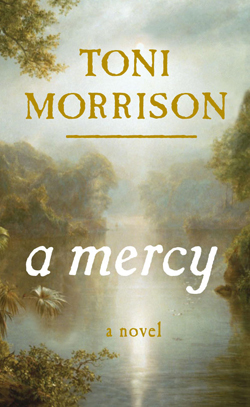
BOOK REVIEW: "A Mercy" By Toni Morrison


Toni Morrison is back! A writer of singular talent, her work is always provocative and elegant. However, recent novels such as Love and Paradise haven't quite reached the heights of her masterpieces Song of Solomon, Sula, and Beloved. Well, after reading her newest novel, A Mercy, I am delighted to say that Ms. Morrison is at the top of her game.

A Mercy, like Beloved, focuses on the lives of the most powerless people in society. In Beloved, the action centered on enslaved African-Americans. A Mercy, set a century earlier, explored of the lives of indentured servants—black, white, and Native American-- a dimension of American history of which many readers will be unaware.

A Morrison novel wouldn't be a Morrison novel without a terrible tragedy at its heart. I won't spoil it here, but Florens, the novel's main characters, struggles to mend her spirit, although the act that caused it is the "mercy" of the title. As in Beloved, we see how destructive a mother's love can be.

A Mercy is a short novel, but potent like strong whiskey. Take your time with it, as each sentence packs a wallop and if you don't watch yourself, you'll be hungover when you're done. These characters will haunt you and won't easily let you go.


For the TRUE Morrison fans out there, you can hear her read from A Mercy on NPR.

Or watch a great interview with Charlie Rose here.


--Tayari Jones
imagineatrium.com


Tayari Jones
is the author of Leaving Atlanta and The Untelling.
Check her out at tayarijones.com

Tuesday, September 30, 2008

BOOK REVIEW: "Company of Liars" by Karen Maitland


Set in 14th century England, Karen Maitland's Company of Liars steals a page from the travel genre in literature made famous by Geoffrey Chaucer's Canterbury Tales, where seemingly random forces bring together extraordinary strangers with fanciful tales to tell. Where Maitland's novel deviates from the classic is in the characters' reasons for being on the road; the ties that bind the group are the lies that they tell, and with each subsequent tragedy, the characters are forced to reveal themselves. In doing so, the truth behind their journey becomes clear. Lurking in the background is the devastation wrought by what would eventually be known as the Black Plague. England is awash in turmoil, undone by a gruesome and painful disease, and escaping the deadly "pestilence" provides each character with a convenient excuse to flee from home. Until, of course, home becomes the conflict within them.

The band of pilgrims—Zophiel, the cynical magician; Jofre, the beautiful boy with the voice of an angel; Rodrigo, Jofre's master and protector; Narigorm, the seer, and her companion, Pleasance; pregnant Adela and her husband, Osmond; and Cygnus, the swan-man—is led by an ambiguous narrator named Camelot, who is smart, resourceful, and frighteningly precise in his observations of those around him. He serves as the obligatory pragmatist, the wisdom that comes with having experienced more misery than one human being ought. Unlike the others, though, he has spent an inordinate amount of time moving from town to town, but he, like the rest, is simultaneously running from his past and towards its inevitable reemergence. Through Camelot's eyes, the characters' life stories unfold into desperate lies, reluctant truths, and fruitless admissions of guilt.

Company of Liars is a smart read, rich with medieval history, social mores, and the religious dogma that undermines an entire country in exchange for immunity. Throughout her tome, Maitland deftly illuminates the Catholic Church's hypocrisy as the ruling institution during Plague-era England, peppering the novel with poignant commentary on the clergy's abandonment of its flock: "You'll be lucky to find a priest anywhere in these parts…. This time last year you couldn't piss without the blessing of a priest; now any Tom, Dick, or Harry, even a woman, can baptise you, marry you, shrive you, and bury you. Makes you wonder why we've been paying all those scots and tithes to the priests all these years, doesn't it?" That this question, representative of religion itself, has weaved its way through each character's story, makes Company of Liars a worthwhile adventure.


--Dianha Simpson
imagineatrium.com


Read the opening chapters of Company of Liars here.

Like this review? Join the community of passionate readers who support local business and self-sufficient communities at Indiebound.org

Friday, August 22, 2008

BOOK REVIEW: "The Black Tower" by Louis Bayard


Louis Bayard's novel, The Black Tower, is like a roller coaster; it builds slowly but before you realize it, you've hit the peak of the hill and the action is moving fast. The first few pages of this book contain a timeline and genealogical charts to help explain the historical context: revolutionary-era France and the family of Marie-Antoinette. During the early chapters I found myself continually referring back to the charts, frustrated at the names (especially the multiple Louises and Charleses!) and family connections tossed around. Once I gave in to the pure enjoyment of reading The Black Tower, though, the novel rewarded me with an unpredictable outcome on the heels of a series of plot twists that I didn't see coming but made sense in the rearview mirror.

The story follows Hector Carpentier, whose financial missteps have left him and his difficult mother running a student boarding house and whose academic pursuits are less than successful. Carpentier unwillingly joins with a notorious French crime fighter to investigate a murder, and the investigation ends up leading them through the story of the lost son of Marie Antoinette and the difficult moral choices faced during revolutionary times. As the plot progresses we also see Carpentier and Vidocq, the inspector, expand into fully-developed and fascinating people, alongside other memorable characters. Bayard creates sympathy for his very flawed protagonists and allows them to carry the story through to its conclusion. The final sequence of events, though rushed and possibly unbelievable, feels right in the context of the entire book.

For readers who enjoy a mystery, or well-imagined history, this will be a pleasure. Aspects of both genres are well-developed and thoughtful, and Bayard's voice is intelligent and enjoyable to read.

---Katy Wischow
imagineatrium.com