Monday, December 29, 2008

BOOK REVIEW: "The Shape of Mercy" by Susan Meissner


The Shape of Mercy is a rather simple story, told from the viewpoint of Lauren Durough, a college sophomore born into affluence. Her family’s money has afforded her many luxuries that she freely discloses at every turn, yet each casual mention of this inventory is coated with disdain. Lauren feigns rebellion, such as opting for a dorm room at UC-Santa Barbara in lieu of a condo at Stanford, and she readily—and frequently—applauds herself for choosing to live among the commoners. But to those who live paycheck to paycheck and struggle to survive, Lauren’s meager acts of rebellion are reminiscent of those of the hippies of the 60s and 70s, who could afford to spend their days fighting "The Man" and finding themselves because Mom and Dad were footing the bill.

One such mutinous decision finds our quasi-protagonist applying for a job transcribing the diary of Mercy Hayworth, an 18-year-old woman accused of bewitching her peers during the frenzy of the Salem witch trials. Lauren’s boss, Abigail Boyles, is a direct descendent of the diary’s author, and thus guards her familial treasure like an overprotective mother. The eccentric, crotchety Abigail hires Lauren specifically because she, too, is an only child borne into great wealth. What she ultimately needs from Lauren is two-fold: to give Mercy’s diary entries a place in history, and to help her peel back the layers of guilt that have suffocated her for most of her life. A tall order for a sheltered college student, indeed.

The problem with Meissner’s novel is that she fails to develop any of the characters beyond Mercy into ones that the reader should care about for longer than it takes to get through the book. Even Lauren’s supposed transformation rings hollow because its catalyst is no more believable than those who set it in motion. Her moral compass, appearing in the form of weak working-class stereotypes, are Esperanza, Abigail’s loyal Hispanic housekeeper; Clarissa, her working-two-jobs-to-put-herself-through-school roommate; and Raul, the devilishly good-looking medical-student love interest who is poor now but probably won’t be in the future. The first two routinely admonish Lauren for viewing life through green lenses while perched up high, languishing among The Haves. But, when the opportunity presents itself—Esperanza’s gifted condo and Clarissa’s salmon steak served on a silver platter by the Durough’s pool—both jump at the chance to abandon The Have-Nots. And Raul? Well, he remains devilishly good-looking and, like in all fairytales, rides in at sunset to save the day a la Prince Charming. How apropos for the princess.

The Shape of Mercy’s story-within-a-story would be worth a read if it was not mired in clunky dialogue (what’s with all the exclamation points?) and an uninteresting primary plot. What Meissner should have done was expand Mercy’s story and keep the parallels strictly between her and Abigail’s lives; both characters are strong enough and mysterious enough to hold the reader’s attention. Juxtaposing the younger woman’s naïveté with the older woman’s wisdom would have eliminated the need for pointless references to modern day materialism and added depth to the reading experience.


--Dianha Simpson
imagineatrium.com

Wednesday, December 17, 2008

BOOK REVIEW: "A Lion Among Men" by Gregory Maguire


A Lion Among Men, written by Gregory Maguire, is the story of the life of the “Cowardly Lion” named Brrr. It was a little slow going in the beginning and at first seemed overly written for my own tastes. But as the story progressed, the style was very fitting in reflecting the life and mannerisms of Brrr. At first glance A Lion Among Men seems to be about the political on goings of the different lands in Oz. Things are in turmoil with the death of the Wicked Witch of the West and the quick exit of the Wizard of Oz.

Brrr is on assignment as court reporter to the Emerald City Magistrates and he has sought out an oracle named Yackle to question her about her knowledge of a certain Madame Morrible. Yackle is an ancient human who is trying to die but has not yet been released from this life. It takes her a while to “warm up” to conversation with Brrr, first demanding to know his history before sharing any of her memories.

He at first tries to brush off her requests but soon is sharing the story of his life, how he became famously known as the “Cowardly Lion” and the events that happened up until the point of the interview. I wanted to feel sympathy for Brrr, given his beginnings as an abandoned lion cub. He learned to protect his own life by cowering down in the face of danger and playing dead. While this worked the first time he encountered danger, he continued to employ this same technique to every situation he encountered, thus entangling himself even more deeply than he ever wanted. What began as sympathy turned to just pity as his difficulty with facing challenging situations kept recurring. His ideals were enacted in his head, but he never went further than that, letting fate control him.

There is also a side story going on about a special clock being guarded by a dragon and a small group of attendants. They are also traveling through the land and eventually cross paths with Brrr, but I won’t give away the reasons why as this is a turning point in the story.

Overall, A Lion Among Men is not an easy read, but it pulls you in and gives you the chance to understand how early events can shape someone’s (in this case a talking lion’s) future life.


---Christine Moss
imagineatrium.com

Wednesday, December 10, 2008

BOOK REVIEW: "Finding the Sweet Spot" by Dave Pollard


Dave Pollard's book, Finding the Sweet Spot: The Natural Entrepreneur's Guide to Responsible, Sustainable, Joyful Work, is a jem for those searching for their life's work. This is not just another business book of tips or self-actualization guide, it is a valuable workbook with thoughtful insights on life and purpose, but written in a playful and approachable style.

The "sweet spot" of which he refers is the intersection between your gifts, passions, and purpose. Pollard's exercises guide the reader with probing questions and real-life examples. His case studies are also interesting and insightful, examining businesses that many people will recognize and appreciate. Finding this "sweet spot" may seem like common sense, but Pollard warns that it can be a challenging process. "It may be iterative – you may start with your Gifts, your Passions, or a need, and go back and forth many times between them before you discover where they intersect."

The book is thoughtfully laid out in a format that is at times akin to a workbook, providing space for the reader to list and sketch ideas and exercises. It's divided into three sections that outline his process in a very organized way – discovering the sweet spot, creating work that aligns, and making it sustainable.

One thing that may not appeal to everyone is that he implies a strong appreciation of social responsibility and readers are expected to have a concern and commitment for environment and sustainability issues. While these underlying concerns are true for many people these days, your work and personal life examples may not align with this. Pollard does show other perspectives though, even differing theories from his own. If anything, the book is a valuable resource for other business and personal work philosophies. On nearly every page, he references or recommends other books and web resources, many that I found myself noting for further reading.

Pollard encourages readers to discover their "natural work" in order to break free of "wage slavery" and dull career progression. His material is presented in an inspiring way and will very much interest anyone curious about her calling and career. It is certainly a sweet reprieve from the everyday business and career books, and will hopefully encourage people to think creatively about their life's work.

--Becky Hughes

imagineatrium.com


Read Dave Pollard's popular environmental and business blog at howtosavetheworld.ca.

Wednesday, December 3, 2008

BOOK REVIEW: "The Transition Handbook" by Rob Hopkins

The Transition Handbook: From Oil Dependency to Local Resilience is an incredibly important book because it provides an introduction to two critical and related issues that we face today. Rob Hopkins first introduces Peak Oil (which received increasing public attention with skyrocketing oil prices this spring) and then explains the role that global warming will play in exacerbating the Peak Oil crisis. Following the description of the crisis, the author attempted to provide a prescriptive formula to address the crisis in individual towns.

In the first section, describing the Peak Oil crisis, Hopkins explains why some of the “new” sources of oil are insufficient. As someone who has not followed the Peak Oil crisis closely, I appreciated some of the simple analogies that Hopkins provided, including his description of retrieving oil from the tar sands in Alberta.

“Tar sands are akin to arriving at the pub to find that all the beer is off, but so desperate are you for a drink that you begin to fantasize that in the thirty years this pub has been open for business, the equivalent of 5,000 pints have been spilt on this carpet, so you design a process whereby you boil up the carpet in order to extract the beer again.”

What was challenging, however, was the use of oil prices along as evidence that the crisis is hitting a pivotal point. While supply had an important impact on price this past spring, so too did hedge fund speculation and the precipitous decline of the American dollar versus other world currencies. The Peak Oil issue did not disappear this fall when oil prices fell, but the oversimplification could lead some people to conclude that it did. The author would have been better served to explain the process to “develop” oil reserves (thousands of years) versus the pace at which those reserves are being depleted.

In addition, it would have been helpful to have a more diverse set of sources to support the peak oil claims (since they exist). There are reports even from the US State Department that indicate that peak oil will be reached sometime between 1990 and 2010, and that the maximum oil reserves are ~2,100 billion barrels (State, 1982). These types of references would help to bolster the argument for the lay person reading the book.


The author is much more effective at linking the peak oil crisis to global warming. Although set in a British context, Hopkins clearly helps to debunk the current political claims that the way to solve the oil crisis is to (A) drill more and (B) use America’s extensive coal reserves to “create” oil. He provides a well articulated argument as to why these solutions would only serve to exacerbate global warming. It would have been helpful to explain the inclusion of that topic in the title, since it is of vital importance to Hopkins’ argument.

Hopkins' solutions and recommendations, such as the 12-step transition town program, are at times overly-prescriptive, overwhelmingly detailed, and difficult to follow. In addition, the view of the world that he paints post peak oil is so entirely unappealing to a huge segment of the population (no global travel, extreme re-urbanization, etc) that it is hard to understand how people would buy-in to the plan. The same solution would be more powerful if it were presented as a “realistic” view of the world, where there are both opportunities and challenges. It is clear that people need to act before the crisis hits, but it is unclear how a large portion of the population will be motivated by Hopkins’ vision. Hopkins does not entertain the idea that transformational technologies could help to smooth the transition (or even a step change in the way we utilize energy for existing technologies). If the author presented his “power down” view along with a call to encourage research into how to do more with less energy, the book would have broader appeal. While he explains why current alternative energy solutions would be ineffective (which was extremely helpful context for those of us who didn’t previously understand that it takes energy to make energy), it was a dismal view of the future that the only way to survive would be retrenchment into a world that looks a lot more like the 1900s than the future.

In spite of the above, this book is great first introduction to the concept of Peak Oil and the need to Transition. It has certainly motivated me to action, if only to research more about what can be done on a personal level to help combat this issue.


--

Monday, December 1, 2008

BOOK REVIEW: "A House in Fez" by Suzanna Clarke


My dream of living in Mexico for a year drew me to read A House in Fez, Building a life in the ancient heart of Morocco, by Suzanna Clarke. Like many of us, the Clarkes went on vacation to an exciting, exotic country and began to imagine what it would be like to live there. The difference is, they took the leap, bought an ancient house in need of major renovation and survived to share their fascinating journey.

Suzanna Clarke is a photo journalist and her writing style is lively, informative and entertaining. Her open-hearted embrace of the Moroccan culture had me thinking it might be appealing to hear loudspeakers calling me to prayer at dawn each day. And I found her adoption of stray cats and abused chameleons truly endearing.

Suzanna and Sandy Clarke are certainly the optimistic, adventurous sort, taking on their renovation project with her high school level French and his smattering of the local Darija dialect of Arabic. Reading this book, I was always eager to learn what happened next, whether they were negotiating with shady inspectors, discovering long buried treasures behind ancient walls or having lumber delivered by donkeys. In fact, the book helped me give my daughter, an interior designer in New York City, a fresh, new perspective in her work. Talking on the phone one day, I couldn't resist telling her, "You think that's bad, be glad you aren't renovating a house in Fez and dealing with runaway donkeys!"


--Jeanne Moren
imagineatrium.com

Purchase A House in Fez at your local, independent bookstore. Find it here.

Wednesday, November 26, 2008

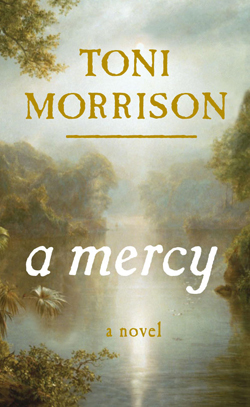
BOOK REVIEW: "A Mercy" By Toni Morrison


Toni Morrison is back! A writer of singular talent, her work is always provocative and elegant. However, recent novels such as Love and Paradise haven't quite reached the heights of her masterpieces Song of Solomon, Sula, and Beloved. Well, after reading her newest novel, A Mercy, I am delighted to say that Ms. Morrison is at the top of her game.

A Mercy, like Beloved, focuses on the lives of the most powerless people in society. In Beloved, the action centered on enslaved African-Americans. A Mercy, set a century earlier, explored of the lives of indentured servants—black, white, and Native American-- a dimension of American history of which many readers will be unaware.

A Morrison novel wouldn't be a Morrison novel without a terrible tragedy at its heart. I won't spoil it here, but Florens, the novel's main characters, struggles to mend her spirit, although the act that caused it is the "mercy" of the title. As in Beloved, we see how destructive a mother's love can be.

A Mercy is a short novel, but potent like strong whiskey. Take your time with it, as each sentence packs a wallop and if you don't watch yourself, you'll be hungover when you're done. These characters will haunt you and won't easily let you go.


For the TRUE Morrison fans out there, you can hear her read from A Mercy on NPR.

Or watch a great interview with Charlie Rose here.


--Tayari Jones
imagineatrium.com


Tayari Jones
is the author of Leaving Atlanta and The Untelling.
Check her out at tayarijones.com

Saturday, November 22, 2008

BOOK REVIEW: "Ghost Radio" by Leopoldo Gout


Ghost Radio, the debut novel from producer/director/graphic artist Leopoldo Gout, is an enjoyable, easy read, and will strike a chord with those that remember the punk scene of the late 1980s, as well as fans of comic books and the paranormal.

The story involves two boys, Gabriel and Joaquin, brought together by a terrible tragedy in their teenage years. Bound together by this experience, they discover a common love of music. They form an experimental punk band, and during a pirate radio gig in Mexico, another terrible tragedy strikes. Joaquin wakes up in the hospital without Gabriel, and with no memory of how he got there.

After the loss of Gabriel, Joaquin channels his energy toward a radio call-in show he hosts called “Ghost Radio”, where callers talk about their paranormal experiences. Bolstered by his technical producer Watt and his beautiful Goth girlfriend Alondra, Joaquin is doing alright. He’s stable and his show has just been picked up in the States—yet when we join the story, unexplained things have started happening to him, and he is starting to get stuck between the stories his callers tell and reality as he knows it.

I had a good time reading this book. As a punk-loving former teen from the time period, I caught the inside references and recognized the names of the bands, although I actually swung between nostalgia and feeling like the name-dropping was a little heavy. However, I really love the fact that the characters are Mexican, and that the story doesn’t treat Mexico as a Third World country or some exotic locale, but as a legitimate place to live, with a youth culture that both mirrors the United States, yet preserves its own past and history.

Also, the concept of the show “Ghost Radio” is fantastic. The ghost stories woven throughout the narrative are the best parts of the novel. In each one, you can sense the caller’s particular viewpoint, and how confused they feel by their contact with the paranormal. Plus, the stories are just realistic enough that they’re pretty spooky.

However, for all the enjoyment I got out of the first two thirds of the book, the ending was completely confusing. The publisher describes this book by saying that Joaquin “opens the doorway into the paranormal, giving voice to the dead and instigating an epic battle for the souls of the living.” What epic battle? Souls of the living? I don’t know that anyone’s soul was really in jeopardy. Maybe Joaquin’s. It was really hard to tell, though. To me, the novel was like one of those episodes of the old “Twilight Zone” show, where the boundaries between reality and madness/paranormal/aliens/etc. are blurred and weird things start to happen, but the show ends with the main character realizing they’re totally screwed, so you never find out what happens. Ghost Radio's ending involves radio waves, electricity, the missing Gabriel, some sort of Mayan cult, and perhaps messages from beyond the grave, but depending on your expectations, might leave you a little frustrated, as it did me.

Aside from the disappointing ending and jarring use of multiple perspectives, the novel was still really enjoyable. Also, each chapter is illustrated with Gout’s fantastic drawings. If you like old-fashioned ghost stories and appreciate the Dead Kennedys, you’ll enjoy Ghost Radio.


---Kimberly Guinta
imagineatrium.com


For more info on Ghost Radio, visit the Official Site